12 November 2012

Gulls on the Gulf

Week 46, 05 November 2012 - Sharq Harbour (Click to enlarge image)

After dropping my son at school, I spent 30-minutes at Sharq Harbour, which is the best time of day with respect to available light. Unfortunately no large white-headed Gulls were to be found, most were far out in the Gulf sitting on the sea waiting for the Dhows to come in to the harbour.

Nevertheless, I still enjoyed the time I had photographing the smaller Gulls and Terns that were foraging in and outside the harbour.

The majority were made up of Common Black-headed Gulls in a variety of plumage types that have arrived in big numbers for the winter.


Wintering Common Black-headed Gull (Chroicocephalus ridibundus) 


Only one Slender-billed Gull was seen amongst the Black-headed


1cy Slender-billed Gull (Chroicocephalus genei)


Sandwich Terns were foraging up and down the coast, a few with deformed beaks (or are they 'growing and moulting'?). Getting an image of one of these Terns in a vertical dive is a challenge with a big heavy piece of glass, but I was able to capture one, just before it hit the surface.


Sandwich Tern (Sterna sandvicensis)


Plentiful food is available for both Gulls and Terns, but these schools normally stay very close to the shoreline for safety.
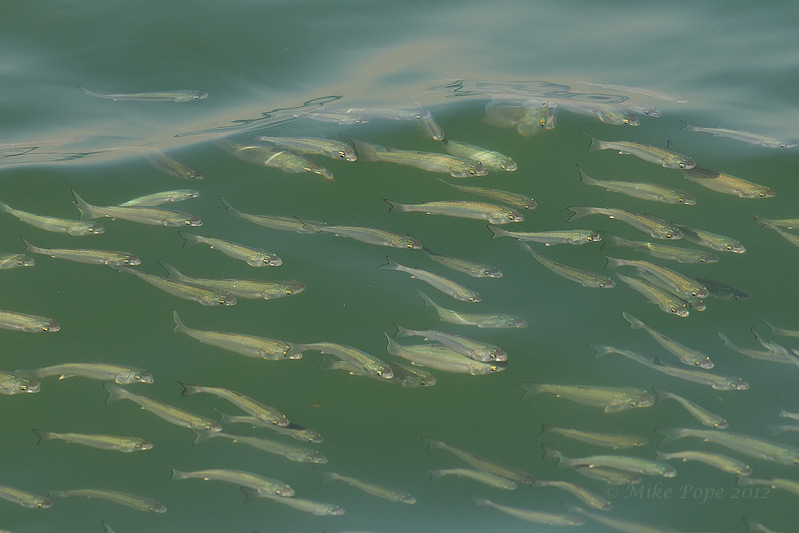

Abundant food supply 

Water, water everywhere

Week 45, 31 October 2012 - Jahra Pool Reserve (Click to enlarge image)

We received the great news earlier this week that the water supply problem to Jahra Pools Reserve had been resolved and the pools were almost all filled; this is great news for the tail end of Autumn migration and the winter visitors.

Here are a few images to show why Jahra Pools is a special and critical site for both resident and migratory birds.

The main pool

Main Pool
The other pools that were filled this week, expanding the habitat for birds

New pool

New pool
The early morning pre-winter light was great for photography and sitting quietly at the main pool, I was able to see and photograph

Blue-cheeked Bee-eater

Blue-cheeked Bee-eater (Merops persicus)
A 1cy Daurian Shrike

1cy Daurian Shrike (Lanius isabellinus)
Winter plumage Black-necked Grebe with it's blood red eyes.

Winter plumage Black-necked Grebe (Podiceps nigricollis)
As well as the usual Little Grebes, the young I had photographed some weeks back almost all grown up now and competing for their own territories

Little Grebe (Tachybaptus ruficollis)

Find your own territory
and a Great Reed Warbler that was foraging in some recently cut reeds. These phragmite reeds seem to grow at lightning speed and need to be managed to ensure that they don't choke the available open water.

Great Reed Warbler (Acrocephalus arundinaceus)
A slow drive around the reserve produced a Red-spotted Bluethroat foraging next to the road

Red-spotted Bluethroat (Luscinia svecica)
My first European Stonechat for this winter

European Stonechat (Saxicola rubicola)
The usual White Wagtails that have now completely replaced the departing Yellow Wagtails at this time of year

White Wagtail (Motacilla alba)
Overhead 5 Steppe Eagles soared gracefully on their way south

Steppe Eagle (Aquila nipalensis)
I saw a lone Western Cattle Egret and these birds have a very special place in my heart; as they symbolise my connection with my late Dad. They seem to "pop" up in the most unusual places and times, often when I least expect it - my Dad's way of saying that I'm still here!

Western Cattle Egret (Bubulcus ibis)
Water Pipits have made a welcome arrival and will stay until the end of winter.

Water Pipit (Anthus spinoletta)
Without much more to be seen on this tranquil morning, I headed home contented.


04 November 2012

Dawn Chorus at Green Island

Week 44, 28 October 2012 - Green Island (Click to enlarge image)

I had an hour to kill, so decided to check out Green Island early in the morning and was really pleased to hear birds singing and calling, as it is something we are not that familiar with in Kuwait, especially not in the urban area I live.

Unfortunately it was an overcast and gloomy day, so light was less than perfect for photography. The main reason I was here was to check for Hypocolius and I wasn't disappointed - they were all over the place, but most feasting on the fruiting date palms. I was able to catch one in flight which is not easy, as the go up fast at around 45 degrees, the rest were all seen fattening up on dates.

Hypocolius (Hypocolius ampelinus)


All the other usual species that can be seen on this man-made island were seen and these included; White-eared Bulbuls which are quite abundant

White-eared Bulbul (Pycnonotus l. leucotis)
It took a little more effort to finally find the Red-vented Bulbul which are resident here, but only a pair or two.

Red-vented Bulbul (Pycnonotus cafer)
On the beach inside the island a pale form Indian Reef Heron was feeding along the shoreline

Indian Reef Heron (Egretta g. schistacea)
The Ruppell's Weavers are still around and have now been present for 2-years

Ruppells Weaver (Ploceus galbula)
A single Daurian Shrike was seen

Daurian Shrike (Lanius isabellinus)
As was a Common Whitethroat

Common Whitethroat (Sylvia communis)
On the way out a couple of Common Myna's were foraging over the litter left where it was dropped after the previous nights festivities.

Common Myna (Acridotheres tristis)


Birding with Ron Peterson

Week 43, 23 October 2012 - Al Abraq and Jahra Pools Reserve (Click on image to enlarge)

I had the pleasure of guiding Ron Peterson on his birthday, while he was here with his wife Jenny visiting their children in Kuwait. Ron is a talented wildlife artist who lives in the UK and didn't expect to see any birds on this visit. 
Fortunately, I managed to change that by taking Ron to 3 very different locations during the morning's birding.

After an early morning start, we headed west to the working oasis farm at Al Abraq where a few shooters tainted what would have been an even more enjoyable morning. Nevertheless, there were still good birds to show Ron.

A few Common Kestrels were found in a few locations around the farm.

Female Common Kestrel (Falco tinnunculus) 
In some of the small fields where crops had been harvested, we found many White Wagtails which winter in Kuwait and these have now almost replaced the migrant Yellow Wagtails which have continued on their journey south. This particular bird had a yellowish tinge to it's white mask, possibly pollen from feeding?

White Wagtail (Motacilla alba)
Tree Pipits have also arrived and a few of these were foraging with the Wagtails or preening in the adjacent acacia trees.

Tree Pipit (Anthus trivialis)
I picked up an interesting small finch like bird in amongst the Wagtail flock that immediately reminded me of a non-breeding or female Whydah that I am familiar with in South Africa. With a lot of patience, we were able to get good views and finally decent photographs for later identification. Once back at home, I consulted The Helm Guide 'Birds of the Horn of Africa' and was able to  identify it as a female Exclamatory Paradise Whydah (Vidua interjecta) that parasites Red-winged Pytilia. It is common in Ethiopia and Sudan which are two of the countries that are closest to the Middle East. In all likely hood it is an escape, but it was fun to finally pin the identification.

Female Exclamatory Paradise Whydah (Vidua intefjecta)


As the morning warmed up, we picked up some Raptors in the form of a few Steppe Buzzards

Steppe Buzzard (Buteo b. vulpinus)


I then had a challenge to get Ron good views of Red-breasted Flycatcher which was not as straight forward as it seems, but finally we did get onto a bird in some dense habitat

Red-breasted Flycatcher (Ficedula parva)


Another bonus just before leaving were two Eurasian Crag Martins, a bird I have not seen for a few years in Kuwait and I was fortunate to get a record image.

Eurasian Crag Martin (Ptyonoprogne rupestris)
From here we had a quick stop at SAANR and the tranquil pools at Tuhla where we found a single Spotted Flycatcher and two Common Redstarts, so we moved on to our final stop at Jahra Pools Reserve.

Fortunately there was still some water in the main pool, but all the others were now completely dried up. We had the usual suspects in the form of Moorhen, Little Grebe, Coot and a single Swamphen as well as a few winter plumage Black-necked Grebe's.

Winter plumage Black-necked Grebe (Podiceps nigricollis)


Driving around the reserve, we got crippling views of Blue-cheeked Bee-eater for Ron that would certainly look good on canvas.

Blue-cheeked Bee-eater (Merops persicus)
Finally, before leaving a Greater Spotted Eagle came sailing gracefully overhead.

Greater Spotted Eagle (Aquila clanga)
It was certainly an enjoyable morning and one in which I could really show Ron what avian delights Kuwait has to offer, even in just a morning's outing and more importantly for Ron, how easy it was to get good views of many normally difficult birds to find in the UK.

Birds and the Bee's

Week 43, 21 October 2012 - Jahra Farms (Click to enlarge image)

A belated post from October when I visited Jahra Farms to give Ali a copy of our recently published "Birds of Kuwait". Every time I have visited Jahra Farm, irrespective of the time of day or year I find Ali working tirelessly around the farm planting and harvesting the crops.

I explained through Khaled Al Ghanem (who kindly translated for me) that this book will help him correctly identify the many birds he already knows and to continue be the guardian of this delightful patch of green in the middle of Jahra town. Here is Ali, hard at work

Ali, hard at work
So, despite the heading I wasn't really here for the birds on this occasion, but found that a bit of colour was showing around the farm in the form of a few Sunflowers and bee's harvesting the pollen.

Sunflowers to brighten Jahra Farm

The bee's
I did however manage to photograph ('macro' with a 600mm) two Dragonflies before leaving which I have yet to identify.