12 May 2013

Off-shore at Sea City and Zour

Week 19, 09 May 2013 - Sabah Al Ahmad Sea City and Mina Al Zour (Click to enlarge image)

The weather had stabilised and improved by the end of last week, so I was able to get off-shore from Sea City without getting wet and my kit sprayed.

The Bridled Terns seen last week were still present this week on the off-shore buoys and this pair was also seen mating in preparation for the coming breeding season on the off-shore islands.

Bridled Tern (Onychoprion anaethetus)

Mating pair of Bridle Terns (Onychoprion anaethetus)


Two Socotra Cormorants were also in the vicinity of the buoys but were initially roosting on the sea

Socotra Cormorant (Phalacrocorax nigrogularis)
We traveled north up the coast to Mina Al Zour and found Lesser Crested, White-cheeked and a few more Bridled Terns roosting on buoys much further out to sea. There was a mixture of ages in both species with some adults already in their breeding plumage, some younger birds and others in moult.

The Lesser Crested are the cool kids on the block, sorry buoy

Lesser Crested Tern (Sterna bengalensis)


Whilst the White-cheeked are more elegant and sophisticated

White-cheeked Tern (Sterna bengalensis)


Suddenly there was a lot of activity in the sea and the Terns all took off in the same direction - we saw the surface water boiling as some predator fish hammered a school of smaller fish. This activity generally doesn't last long and when we got there only the Bridled Terns remained, as the bait ball had gone deep and moved off - only to re-appear about 100m further a little later.

Bridled Tern (Onychoprion anaethetus) over the feeding frenzy

You can just see the predator and prey fish below and to the left of the Tern
During this opportunistic feeding frenzy a flock of 13 Socotra Cormorants flew in out of nowhere, certainly the biggest single flock I have ever seen in Kuwait. The joined in the fray, but were also just too late

The flock of 13 Socotra Cormorants (Phalacrocorax nigrogularis)


Once back on dry land, I found a Sedge Warbler in some suitable habitat, a species I had not seen in Sea City on previous visits.

Sedge Warbler (Acrocephalus schoenobaenus)

Exploring a new area

Week 19, 07 May 2013 - Doha Area and JPR (Click to enlarge image)

One of the KEPS Members had told me about an area near Entertainment City where he had found Indian Silverbill. I have seen this species many times around the Gulf, but it has eluded me in Kuwait.

I spent about 90-minutes in the area which has some good habitat in a fenced area that is currently not accessible, but is probably where the Silverbills are more likely to be found. No luck with the Silverbills, but with time I should find them, however a pair of Yellow-throated Sparrows was reward enough for the time spent.


Yellow-throated Sparrow (Gymnoris xanthocollis)
I then moved to Jahra Pools (although mid-morning light was not ideal for photography) and saw that many of the Curlew Sandpipers are now sporting their brick-red breeding plumage


Curlew Sandpiper (Calidris ferruginea) in breeding plumage


There was only one Dunlin present, but I was able to get a record image of it together with a Curlew Sandpiper for comparative purposes


Comparative image of Curlew Sanpiper (Calidris ferruginea) and Dunlin (Calidris alpina)


There were still good numbers of Red-necked Phalarope in one of the main pools, this one taking a break from spinning around


Red-necked Phalarope (Phalaropus lobatus)
In previous visits I had only seen male Little Bitterns so it was good to see a female this visit. With the favourable and stable water conditions at JPR through the winter and spring, there is a good chance that this species may be breeding in the dense reed beds.


Female Little Bittern (Ixobrychus minutus)

Cook hair!
Numbers of White-winged Tern were present today, some roosting on the sand bank and others feeding over the pools


White-winged Tern (Chlidonias leucopterus)
A single Daurian Shrike was unexpected as most have already moved on..


Daurian Shrike (Lanius isabellinus)
Spotted Fly's are now relatively easily seen in suitable habitat


Spotted Flycatcher (Muscicapa striata)
Hey Dad!


Western Cattle Egret (Ardea alba)


08 May 2013

An afternoon at JPR with good friends

Week 18, 02 May 2013 - Jahra Pools Reserve (Click to enlarge image)

My friends and collaborators Stam and Aris from Bio-diversity East were in Kuwait for a couple of days and we had the chance to meet and enjoy a few hours birding in the late afternoon at Jahra Pools.

They hadn't visited since Birds of Kuwait was launched and were quite impressed with the upgraded road and water infrastructure in the reserve.

Indeed the water network is the life-blood for this reserve and as a result many species have bred this spring including Mallard and Ferruginous Duck.

We spent the time birding, so not too many photographs were taken. But as expected, Red-backed Shrikes are still predominant, although numbers are now starting to reduce as they continue their journey north.

Male Red-backed Shrike (Lanius collurio)
Not too many passerines today, but there were numbers of Common Whitethroat

Common Whitethroat (Sylvia communis)
This Yellow-headed Wagtail stood out from the few others that still remain

Yellow-headed Wagtail (Motacilla f. lutea)
A female Namaqua Dove was seen and is a species that we don't see that often outside of the Pivot Fields (where unfortunately we no longer have access).
Female Namaqua Dove (Oena capensis)
There were quite a few juvenile Little Grebes in the various pools

Juvenile Little Grebe (Tachybaptus ruficollis)
As well as around 5 Garganey, the male is quite stunning in breeding plumage

Male Garganey (Anas querquedula)
The Black-winged Stilt still appears to be sitting tight on it's nest - so hopefully the young are coming soon

Nesting Black-winged Stilt (Himantopus himantopus)
For those that have read my earlier posts, you will know that the Cattle Egret holds a special place in my heart

Western Cattle Egret (Bubulcus ibis)
A Spotted Crake was a good bird for Stam and Aris

Spotted Crake (Porzana porzana)
However, the bird(s) of the day for all of us was finding a pair of Purple Swamphens with their two juvenile birds (another JPR breeding record) - just venturing out into the open. The adults were a little nervous, so soon ushered the young back into the reeds.

Juvenile Purple Swamphen (Porphyrio  porphyrio)


Adult and juvenile Purple Swamphen (Porphyrio  porphyrio)
But, that was a great sighting to end the day and to again say cheers to Aris and Stam until their next visit.

The Islands of Sea City

Week 18, 02 May 2013 - Sabah Al Ahmad Sea City (Click to enlarge image)

Earlier this month I was down at Sabah Al Ahmad Sea City where I spent some time monitoring migration on the Islands in Phase A1.

Many migrants were still passing through, but still Red-backed Shrikes made up the majority and there appeared to be a lot of scuffling around their temporary territories

Male Red-backed Shrike (Lanius collurio)
The odd Woodchat Shrike was also seen

Woodchat Shrike (Lanius senator)
Only female Common Redstarts were seen, the majority of males had already passed through a few weeks back

Female Common Redstart (Phoenicurus phoenicurus)
There were good numbers of Warblers, with many Common Whitethroats, but Willow Warblers make up the majority

Willow Warbler (Phylloscopus trochilus)
There seem to be equal numbers of Barred Warblers passing through

Barred Warbler (Sylvia nisoria)
along with Upcher's Warblers

Upcher's Warbler (Hippolais languida)
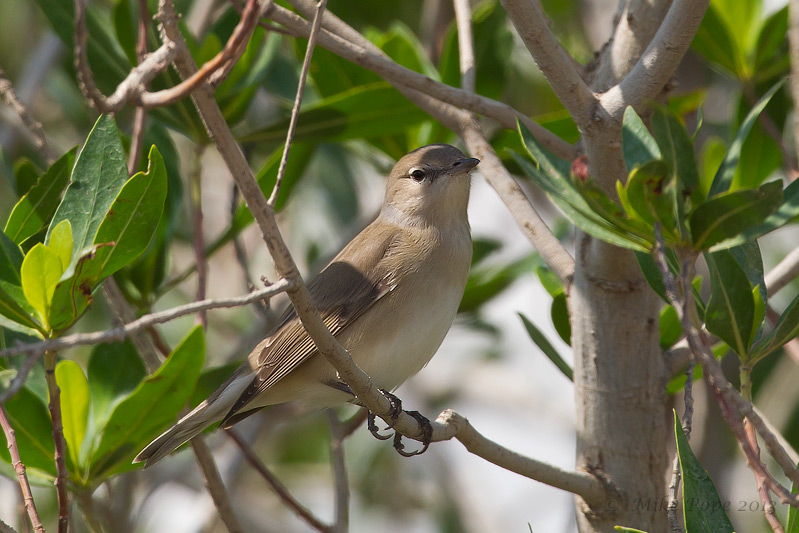
Two Garden Warbler were seen, my first for this migration, but remained inside the cover of the growing trees

Garden Warbler (Sylvia borin)
Rufous-tailed Scrub Robins are also now seen in most areas.

Rufous-tailed Scrub Robin (Cercotrichas galactotes)
The two best birds of the day were 2 Corn Crakes followed by 2 European Nightjars. Neither of these birds could be relocated after they were inadvertently flushed, despite the small area of the island; so that was a little frustrating to say the least.

A quick trip off-shore produced two Bridled Terns on the buoys, which have returned to our shores for the coming breeding season on the off-shore islands.

Bridled Tern (Onychoprion anaethetus)