16 August 2016

From Dusk to Dark

Week 33, 12 August 2016 - Jahra Pools and Sulaibiya

No posts in Kuwait for last weekend, as I was visiting my good friends in Qatar (see the post here - http://kuwaitbirding.blogspot.com/p/around-region.html)

I had mentioned in a previous post about the sweet afternoon light at Jahra Pools, so after a morning of tennis (yes, we play all year round!) and some time at the pool I was back at JPR in the late afternoon. A single Black-tailed Godwit was seen in one of the pools

European Black-tailed Godwit (Limosa l. limosa)
And a young Grey-headed Swamphen was foraging in the reeds

This year's Grey-headed Swamphen (Porphyrio  p. poliocephalus)
Again, I found a likely spot, opened all the windows and switched off the engine and leaked while I photographed the birds in the pool in the golden hour. Most of the birds were the same as the previous week, but with a few new additions. Dunlin still present

Dunlin (Calidris alpina)
But Curlew Sandpiper was new

Curlew Sandpiper (Calidris ferruginea)
A small flock of Greater Sand Plover flew in, but didn't stay long

Greater Sand Plover (Charadrius leschenaultii)
One of this year's Little Ringed Plovers was foraging in the shallow water

This year's Little Ringed Plover (Charadrius leschenaultii)
Wood Sandpipers were also a new addition to the birds seen last week

Wood Sandpiper (Tringa glareola)


But White-winged Tern numbers seemed to have increased.

White-winged Tern (Chlidonias leucopterus)


As the light was fading fast, I had a quick drive around the reserve - Yellow Wagtails numbers are also slowly increasing

Black-headed Wagtail (Motacilla f. feldegg)
I found a family of 5 Little Ringed Plovers all foraging on a raised mound of sand - it seemed there were small insects coming out of the sand to feed and the Plover family made the most of this unexpected food supply

Adult Little Ringed Plover (Charadrius leschenaultii)
I took this abstract landscape

Jahra Pools Landscape
Followed by a few Black-crowned Night Herons that were getting pretty vocal from their roost

Adult Black-crowned Night Heron (Nycticorax nycticorax)

Calling Juvenile Black-crowned Night Heron (Nycticorax nycticorax)
Just before the sun set (I'm a sucker for sunsets/sunrises)

Another Jahra Pool sunset
As I was going past Sulaibiya on the way home, I made a stop to try locate Barn Owl and get that elusive photograph - no luck this time in even seeing the bird. 

There was however a Green Toad eruption, with so many Toads all over the desert. So, I got down to their level (lying flat on the sand), to get a few images.

Green Toad (Bufotes (Bufo) variabilis)


A single Desert Gecko was also seen, but was less obliging than the Toad's - same tactic again; get down on the sand!

Desert Gecko (Stenodactylus doriae)
Again, an enjoyable afternoon and evening out - still no Owl image though!

A Mega Day

Week 30, 30 July 2016 - Mutla'a Ranch and Jahra Pools

It was a year ago today that Neil and I found Kuwait's first Sabine's Gull, so we decided we had to go out today and see if we could find something special in the mid-summer heat.

Neil went direct to Jahra Pools, whilst I said I would check out Mutla'a Ranch at first light. No Barn Owl and other than one or two migrants, just the usual resident suspects; Crested Lark

Crested Lark (Galerida cristata)
and Namaqua Dove

Female Namaqua Dove (Oena capensis)
So, back down the ridge to Jahra Pools to check the birds on the high tide line with Neil. Whilst driving through the reserve, I had my first Red-throated Bluethroat of the autumn. I was just lining up the photograph, when my phone rang - it was Neil, get here quick I have a possible Arctic Tern in my scope!

Red-spotted Bluethroat (Luscinia s. svecica)
I wasn't far away, so within 5-minutes I was checking the roosting Tern through the scope and it certainly had all the attributes of Arctic, plus Neil had also seen it flying. This will be the 7th record for Kuwait, if accepted by KORC. The bird was a long way off and with the heat haze coming off the sand, even a record image was tough. But I managed a few images to add to the Rarity Form.

7th Arctic Tern (Sterna paradisaea) for Kuwait - pending KORC acceptance


While standing chatting, we talked again about Black Tern and sure enough we picked up one a little further away than where the Arctic Tern was roosting - this the 16th record for Kuwait..

16th Black Tern (Chlidonias niger)
In the same area, but feeding on the banks was the Western White Stork that was still present.

Western White Stork (Ciconia ciconia)
In amongst the waders on the shoreline were a few Lesser Sand Plovers in breeding plumage. Again heat haze played havoc with image quality...

Lesser Sand Plover (Charadrius atrifrons)
Shortly after this Neil had to reluctantly leave. I saw that there were quite a few Terns (including the Black) feeding over the outfall in the reserve, so I headed there in my car where I also had slightly better light. In fact, I photographed all 3 Marsh Tern species feeding over the outfall which was a real win!

1. Black Tern

16th Black Tern (Chlidonias niger)


2. Whiskered Tern

Whiskered Tern (Chlidonias hybrida)


3. White-winged Tern

White-winged Tern (Chlidonias leucopterus)


Today again proved that even in adverse weather (in terms of mid-summer temperatures), good birds can be found if you are prepared to get out and sweat it out in the mid-day heat (it topped out at 50 degrees today!)

Sweet afternoon light

Week 31, 29 July 2016 - Jahra Pools Reserve

After a few disappointing morning outings to Jahra Pools Reserve, I opted for a different tactic by heading out in the late afternoon. Primarily as this is a better time for photography in the few pools that can still be seen. Reed growth has been phenomenal this summer - great for the birds in terms of cover, but not so for the birders and photographers.

Checking a few gaps in the reeds, I found a splendid Squacco Heron in all it's breeding plumage finery...

Squacco Heron (Ardeola ralloides) in breeding plumage
There were both young and adult Eurasian Coot around

Juvenile Eurasian Coot (Fulica atra)

Adult Eurasian Coot (Fulica atra)
Overhead a couple of Caspian Terns were patrolling and hunting over one of the larger pools

Caspian Tern (Hydroprogne caspia)
As was one of this years Gull-billed Terns

Gull-billed Tern (Gelochelidon nilotica)
I then found a good spot, opened all the window and switched the engine off - not great for body fluid loss, but essential to reduce any engine vibration while shooting with my camera resting on a beanbag on the windowsill. After a 15-minutes, the birds relax and others that had flushed return and enjoyed a good hour with the late afternoon sun behind me and very little wind.

Little Stint's were the most predominant species

Little Stint (Calidris minuta)


A few Dunlin were interspersed within the flock

Dunlin (Calidris alpina)
Black-winged Stilt is a naturally photographic species

Black-winged Stilt (Himantopus himantopus)
This Grey-headed Swamphen does not look like it belongs in the air...

Grey-headed Swamphen (Porphyrio  p. poliocephalus)
By now the sun was low on the horizon and the light had faded, so I started driving back slowly to the gate and on one of the tracks I found Black-headed Wagtail

Black-headed Wagtail (Motacilla f. feldegg)
as well as my first Eurasian Hoopoe of this Autumn

Eurasian Hoopoe (Upupa epops)
Grey Herons and Western Great Egrets had flown in to roost for the night

Heron silhouette at sunset
Just as the sun set

Jahra sunset
This was an enjoyable afternoon, that I will certainly repeat...


Above and below the sea

Week 30, 23 July 2016 - Sea City

Earlier in the week, I had decided to head south to Sea City to check for migrants and spend a few hours on the beach.

Of course, the weather had other plans and during the night I could hear that the wind was picking up speed. Since I had already committed to myself, I got my gear and headed to Sea City, stopping for an Egg McMuffin breakfast on route. 

I was hoping that the wind would die down as it sometimes does - just not today...I did see some early migrants; Upchers Warbler, Isabelline Wheatear, Common Sandpipers - but not one was kind enough to pose for a photograph. But who could blame them, as even I was battling with the wind battering the car and blowing dust. I did find a Blanfords Agamid that seemed determined not to be swayed by the wind..Something disturbed it and suddenly it was off across the mound, all puffed up and displaying - defending it's territory?

Blue-throated (Blanford's) Agamid (Trapelus ruderatus fieldi)

Let the display begin.....

You wanna a piece of me?

I thought not!

Next!
I then headed for the beach and found a sheltered spot out of the wind. I wanted to test the GoDome I had purchased in SA for split level images. But first I had to find a subject and that in itself was a challenge. Eventually I found a large and live Sand Dollar; one of the biggest I have seen. As their shell is covered in fine 'hair' they are able to move very slowly on and under the sand which I didn't know..

Split level image of Sand Dollar (Echinodoscus auritus)

Sand Dollar (Echinodoscus auritus) disappearing under the sand
I was pleased with the first test of the GoDome but will need to try it again in more favourable conditions and clearer water...

Feeling a little wind swept and sand blasted - my stay on the beach was shorter than I had planned.

The Owl and the Moon

Week 30, 22 July 2016 - Mutla'a Ranch and Jahra

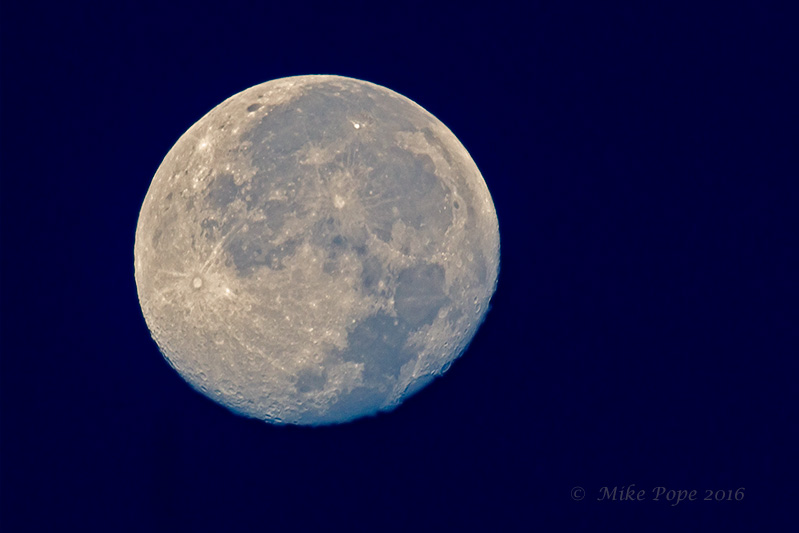
The almost full moon was low in the sky when I left home in the pre-dawn, opting to head north over Jal Al Zour escarpment to Mutla'a Ranch in the hope of finding some early migrants.

Early morning full moon - almost!
No luck with any migrants, but walking through the dense palm grove I flushed a Western Barn Owl (a species I suspected to occur on this farm). Trying to relocate it was like looking for a needle in a haystack, but after 20-minutes I did. Unfortunately, it had better eyesight than me, so as I lifted my camera and pressed the shutter, it was off again. As it was so gloomy inside the palm grove, I still don't have the image I want of Barn Owl!

Western Barn Owl (Tyto alba)
From here, I headed back down the escarpment to Jahra Farm with the mercury rising pretty quickly. A quick walk around the farm produced both Myna species (Common and Bank) and surprisingly a few European Starlings (a species that normally occurs late autumn/early winter), as well as a lone Western Cattle Egret (hey Dad!)

Western Cattle Egret (Bubulcus ibis)
Last stop was Jahra Pools, just on the other side of Highway 80. Graceful Prinia's were pretty vocal in the desert shrub after the entrance gate.

Young Graceful Prinia (Prinia gracilis)
The Grey-headed Swamphen's appear to have had a good breeding season, with both adults and juveniles seen

Adult Grey-headed Swamphen (Porphyrio  p. poliocephalus)
At the large pool I was checking for Black Tern (as they have been recorded in July in previous years), but it was just the White-winged Tern that was still present

White-winged Tern (Chlidonias leucopterus)
However, for this morning the 3 European Black-tailed Godwit's, a Near Threatened species, were much more interesting.

European Black-tailed Godwit (Limosa l. limosa)
Yellow Wagtails have now arrived and there numbers should increase in the coming few weeks..

Black-headed Wagtail (Motacilla f. feldegg)
Very little else was seen, as a brisk and scorching 'hair dryer' wind picked up and both the birds and I headed for cover