05 February 2012

2-days Guiding

Week 03 - 20 and 21 January 2012 - various sites in Kuwait

I had the pleasure of guiding David Fisher from the UK for 2-days and to find a few specific species he was after.

This winter has been one of the more dismal years for Hypcolius, for unknown reasons and of course this was David's key target bird.

After picking David up from the Ibis we headed straight to Green Island, Jahra Farm and back to Green Island for this enigmatic species. The fruiting trees they normally feed on in winter had already lost their fruit, so we check all other trees and palms that may have fruit - but to no avail.

We did find White-eared Bulbul, one of the easier target species

White-eared Bulbul (Pycnonotus l. leucotis)

Of interest the male Ruppells Weaver (present last year) was in the process of nest building in full breeding plumage. There is no reason why this species should not establish a sustainable breeding population over the coming years
Ruppells Weaver (Ploceus galbula)
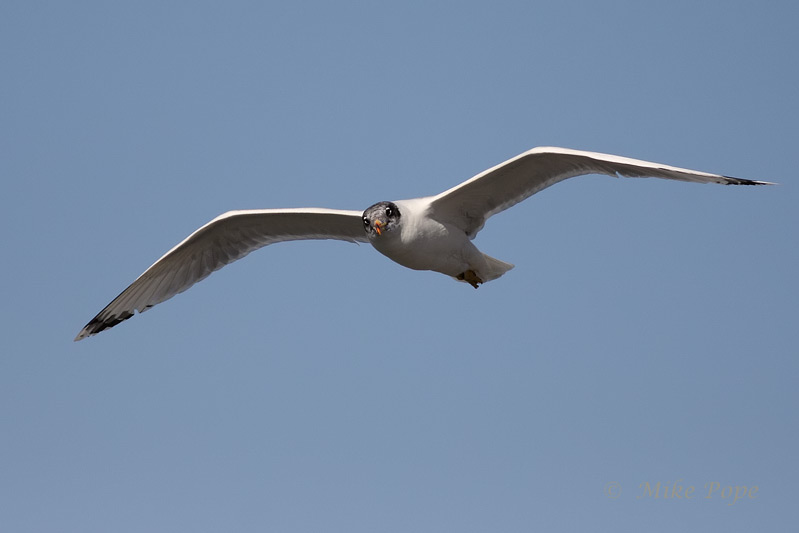
Since we had no luck with the key bird, we headed off stopping at Sharq Harbour and finding a stunning Great Black-headed Gull

Great Black-headed Gull (Larus ichthyaetus)


No luck at all with Crab Plover in Sulaibikhat or Doha Spur, but a Long-legged Buzzard was a consolation

Long-legged Buzzard (Buteo rufinus)
We then headed to Jahra Pools finding many Pallid Swift hawking over the ponds

Pallid Swift (Apus pallidus)
together with Barn Swallows - it appears some may have over-wintered in Kuwait
Barn Swallow (Hirundo rustica)
Along the Jahra coast we were very fortunate with an obliging Macqueen's Bustard and the best views I have had since arriving in Kuwait in 2006 and a great bird to wrap up the first day's birding.
Macqueen’s Bustard (Chlamydotis macqueenii)


 Saturday brought bitterly cold weather and the mercury didnt get into double figures the whole day. We headed to Pivot Fields, but could not get access today. As it was still early, we headed a long way south just past Khiran and were successful in finding Red-tailed Wheatear, in fact this was the only bird we found at this site.

Red-tailed Wheatear (Oenanthe chrysopygia)


Although a long drive, it was worth it for David. Now it was back up to Green Island in time for the gates to be opened. A Red-vented Bulbul was of no interest
Red-vented Bulbul (Pycnonotus cafer)
I had talked to Pekka who described where only one bird was seen earlier in the week (although I had already checked this place carefully yesterday). David and I agreed to stay in this place for as long as possible and would you know, we were rewarded with a single male bird that flew in. Very quickly it dropped down to feed briefly on some dates lying on the floor before disappearing. It re-appeared later to quickly feed and then was not seen again - but David was elated, as was I.

Hypocolius (Hypocolius ampelinus)
We stopped again at Sharq harbour finding another Great Black-headed Gull

Great Black-headed Gull (Larus ichthyaetus)
and many Common Black-headed Gulls

Winter plumage Common Black-headed Gull (Chroicocephalus ridibundus)


together with a few Caspian Gulls

Caspian Gull (Larus cachinnans)
Again no Crab Plovers at Sulaibikhat, but we did find around 137 Pied Avocets

Pied Avocet (Recurvirostra avosetta)
A brief stop in SAANR didnt produce to much with birds doing their best to stay out of the cold, although we did find a male Desert Wheatear to wrap up the 2-days birding. For David, bird of the trip was undoubtable the Hypocolius with a few other highlights in what was an enjoyable 2-days birding.

Male Desert Wheatear (Oenanthe deserti)

09 January 2012

Heavy cloud, little rain

Week 01 - 07 January 2012, Jahra Pools, Jahra Bay, SAANR and Sulaibikhat Bay

My first day out in this new year and it was a dull and overcast day with enough precipitation to only dirty your car. I was going to start at Pivot Fields to see if the Dotterel was still present, but access was not allowed today, so it was off to Jahra Pools.

Unfortunately a lone shooter had gained access to the reserve and spooked all the birds when he tried to shoot at some Flamingoes. I alerted the guards who soon chased him off - but it is sad that a shooter will disregard the fact that this is a reserve where birds are supposed to be protected. Here the Greater Flamingos taking flight with the adult sporting a broken leg, not sure if this was caused by the shooter.

Greater Flamingo (Phoenicopterus roseus)

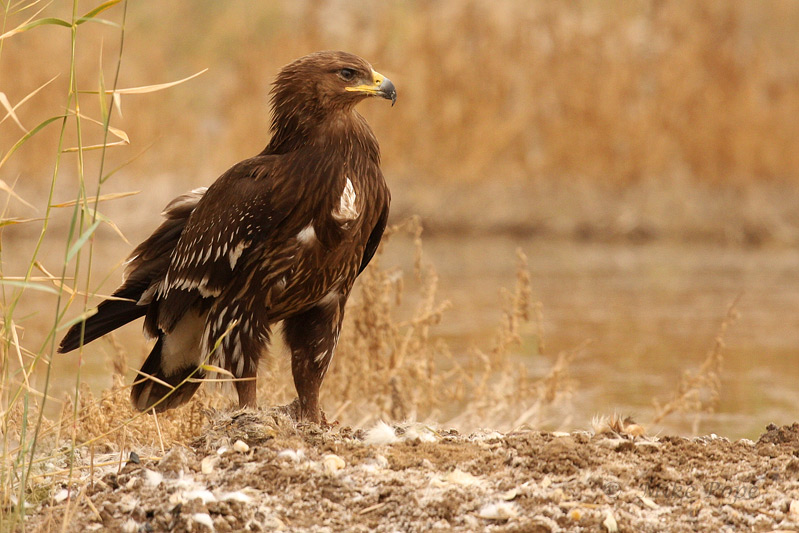
I did find a Greater Spotted Eagle away from where the shooter was with a full crop. Judging by the feathers around it's feet, it was an avain breakfast.

Greater Spotted Eagle (Aquila clanga)


Chiffchaff's were abundant in the reedbeds, although light was poor, I caught this one trying to snap a passing gnat and a few others gleening in amongst the reeds

Common Chiffchaff (Phylloscopus collybita)


After the shooter was chased off, the Tufted Duck that has been around for a week or so, made an appearance from where it was hiding.

Tufted Duck (Aythya fuligula)

Coot numbers have really increased with the stable water conditions

Eurasian Coot (Fulica atra)

From here I drove along the coast from Jahra East where I was really surprised to see Macqueens Bustard - I guess this is the first bit of land they find, if they have migrated across the Gulf


Macqueen's Bustard (Chlamydotis macqueenie)

I finally got to SAANR, where some light rain started to fall so not too much was seen other than a foraging Greater Hoopoe Lark

Greater Hoopoe Lark (Alaemon alaudipes)

Three species of Wheatear, with Isabelline being the most common

Isabelline Wheatear (Oenanthe isabellina)

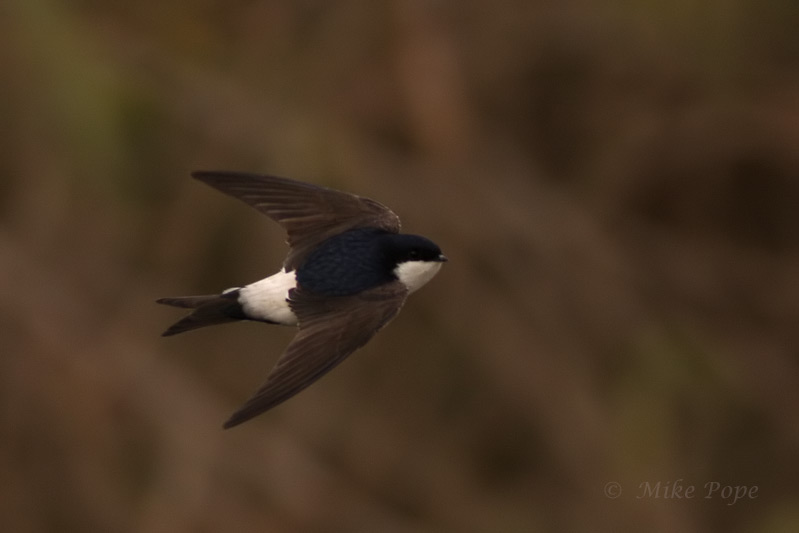
A Barn Swallow together with a Common House Martin at Tuhla was checked carefully to make sure it was not Asian House Martin at this time of year - it wasnt, as it had pale not dark underwing coverts!

Common House Martin (Delichon urbicum)


On the way to the gate, a Mauryian Grey Shrike posed obligingly for a photograph, this one taken as a RAW image (my new years resolution is to try and get to grips with RAW)

Mauryan Grey Shrike (Lanius lahotra)

The last stop on the way home was Sulaibikhat Bay where I found a huge flock of Greater Flamingos (no Lesser lurking amongst them) as well as a big flock of Mallards

Mallard (Anas platyrhnchos)


Common Shelduck

Common Shelduck (Tadoma tadoma)

and on the shores Terek Sandpiper

Terek Sandpiper (Xenus cinereus)

Common Greenshank

Common Greenshank (Tringa nebularia)

and large numbers of Common Black-headed Gulls all still in winter plumage

Common Black-headed Gull (Chroicocephalus ridibundus)


and a few Heuglins Gulls

Heuglins Gull (Lanius f/h heuglini)

and fewer Gull-billed Terns (this one and the next hand-held with the 600mm)

Gull-billed Tern (Gelochelidon nilotica)

There was another Tern that I managed to get one image, which I suspect may be Common

Possible Common Tern?

Not too bad a morning overall, despite gloomy conditions, with 42 species recorded

02 January 2012

2011 - The year that was

31 December 2011

Like all good things 2011 has now come and gone and was filled with both high's and low's in all respects, but as time and life is precious we must appreciate it for what it was.

So, we say goodbye to 2011 and look forward to 2012; may it be all that we wish for and more!

2011 - It is not over, until it is over

Week 52 - 30 November 2011, Jahra Pools, SAANR and Pivot Fields

On the 29th (a working day) 9 Red-crested Pochard were found by Bouda at Jahra Pools. The family 'granted' me a pass on the New Years weekend, so at 6:45am I was at the reserve gates with the temperature reading 5 degrees, so it was fresh.

As it was still to early, there was no sign of any life at all on the pool, but as the sun slowly rose birds started appearing.

I was quite surprised to see a large flock of Greater Flamingo fly in, normally these birds are only seen here in one's and two's

Greater Flamingo (Phoenicopterus roseus)

A Eurasian Sparrowhawk also made a brief appearance

Eurasian Sparrowhawk (Accipiter nisus)

Finally a flock of ducks was seen at the far end of the pools and these were identified as the flock of 9 Red-crested Pochards, really smart looking ducks. I put the 1.4 extender onto the beast, but they never came close enough for frame filling images. The early morning and distance over water is far from ideal for an extender too, so image quality was a little disappointing for a bird that deserves more. Nevertheless, a great tick for the year.

Male Red-crested Pochard (Netta rufina)

Male and female Red-crested Pochard (Netta rufina)

I thought I would try for the Common Cranes at SAANR, but alas had no luck finding them. However, on the way home I received a call from Pekka who had found a single Dotterel at Pivot Fields, so I was able to make the detour to see,  but not photograph the bird.

From a birding perspective, a very rewarding last week of 2011 with 3 new species added to my Kuwait list

29 December 2011

2011 Kuwait Round-up

Week 52 - 29 December 2011

Well another eventful year gone by in what feels like a flash and 2012 rushing headlong toward us…

From a birding perspective and being on the migration route, Kuwait had another exciting year with a few 1st records and many other rarities showing up during the course of the year.

I ended the 2011 birding year on a good note with 11 Greylag Geese in Jahra, a bird which I had'nt yet seen in Kuwait, so a lifer for me. 2010 finally took me over 300 to 303 species and for 2012 I finished up on 307 species out of the 387 species recorded in Kuwait.

As KORC (Kuwait Ornithological Rarities Committee) we adjudicate and ratify all vagrants reported in Kuwait to ensure that they are genuine records. Once a species is recorded 15 times, we then review its vagrant status based on frequency of sightings. With more and more birders/photographers reporting their sightings we are getting a better understanding of distribution and status of rare species. A very good example in the 5-years I have been in Kuwait is Black-winged Kite that is now considered an annual but uncommon visitor, when in 2006 it was still considered a vagrant.

On that note, here are the highlights for 2011

1st records – Pied Bushchat, Striated Heron, Pectoral Sandpiper and Masked Wagtail (considered a sub-species of White Wagtail)
2nd records – Mongolian Finch and Red Knot
3rd records – Long-tailed Skua and Grey-necked Bunting
4th records – Humes Leaf Warbler
5th records – Arctic Tern
7th records – Common Crane
8th records – Pale Crag Martin and Ferruginous Duck
9th records – Eversmanns Redstart, Rufous Turtle Dove, Eurasian Golden Plover, Ferruginous Duck and Common Crane
10th records – Spur-winged Plover, Rufous Turtle Dove and Eurasian Golden Plover
11th records – Dead Sea Sparrow
12th records – Dead Sea Sparrow and Black Stork
13th records – Black Stork
14th records – Black Stork
15th records – Crested Honey Buzzard and Black Stork

HOT OFF THE PRESS
Just as I was typing this I get news of a flock of 9 Red-crested Pochard found by a local Kuwaiti birder that if accepted by KORC will be another FIRST for Kuwait' so now a total of 388 species for Kuwait (pending KORC Acceptance of the record)

Now we look forward to the coming Spring migration with migrants returning in preparation for the coming breeding season as well as the winter residents slowly change from non-breeding to breeding plumage in preparation for their departure toward the end of Feb and early March.

Here are a few images of vagrants for the year 2011

Pectoral Sandpiper was a 1st and found at the Pivot Fields during October where it remained for almost a week.

Pectoral Sandpiper (Calidris melanotos)

The Red Knot was a 1-day bird found at Jahra East Outfall and the 2nd record for Kuwait

Red Knot (Calidris canutus)

The 9th record of Rufous Turtle Dove was found by Brian Foster and I in March at Jahra Farms

Rufous Turtle Dove (Streptopelia o. meena)