01 August 2014

Slow boat to Qaru

Week 31, 30 July 2014 - Qaru Island

A few Biodiversity East members and friends had the opportunity of joining a dive charter departing from Khiran to Qaru Island for a days exploration and snorkeling.

A full Silsan departed at 9am and we chugged our way East across the Arabian Gulf to Qaru in pretty choppy seas with some big swells that had a few passengers looking decidedly 'green in the gills' - I was sea watching in the hope of some pelagic bird species, but only had Socotra Cormorant, Lesser Crested Terns and Bridled Terns. 

Bridled Tern (Onychoprion anaethetus)
After 3-hours we finally reached Qaru where the weather had settled a little. 
As we weren't diving, the tender boat took us to shore and we had some time to explore this very small but important sandy island. No Terns breed on this island, but rather on Kubbar which is north of Qaru.

Of course I checked for signs of passerine migration and found Rufous-tailed Scrub Robin and 7 Eurasian Hoopoe roosting and flying around the radio mast.

Eurasian Hoopoe (Upupa epops)
Around the Coastguard Building there were a few Eastern Olivaceous Warbler

Eastern Olivaceous Warbler (Iduna pallida)
And a single Yellow Wagtail feeding on a cricket of which there has been a huge influx over the past week - crickets literally everywhere

Yellow Wagtail (Motacilla flava flava)
There is a species of Dragonfly on the island that I havent seen on the mainland - so a bit of DIF (dragonfly in flight) action - not that easy either!

Dragonfly sp


After a bit of snorkeling where the colours of reef fish are as amazing as some of the passerine migrants it was time to head back to Khiran on the Silsan.

Silsan Dive Boat
Slowly, very slowly Qaru Island faded into the distance

Qaru Island
Fortunately the wind had abated so it was a smoother trip home and the passengers were able to keep their lunch inside, instead of feeding the fish.

Bridled Tern heading to a roost

29 July 2014

Mission Accomplished

Week 31, 28 July 2014 - Boubyan, North Kuwait

I was on a mission to get better photographs of the 3rd Mudskipper species in Kuwait - Slender Mudskipper.

An early start to catch the low tide, meant a fair drive north, then east and north again toward Boubyan Island and stopping on route for a few landscape images

Camel grazing with a Jal Al Zor backdrop

The only switchback road in Kuwait

Jal Al Zor

In this northern area there are also extensive mudflats - but finding a suitable one was a challenge.

Eventually I did find one and after scanning it for some time saw that there was quite a bit of activity on the flats. The problem was that since it was early I would be photographing into the sun - my problem was solved when I found an old slipway, so could get closer to the low tide and photograph back to the beach with the sun behind me. So I plonked myself down on my backside and sat for over an hour enjoying the animated activities of these fascinating amphibious fish. May I present to you, Scartelaos tenuis, who by the way has impressive blue eyes when the catch the light just right!

Slender Mudskipper (Scartelaos tenuis)


As with the mudflats in the south, there are some large Crabs that co-exist on the mudflats with the Mudskippers

Macrophthalmus dentipe
After an enjoyable morning, I headed back toward home stopping first at McDonalds to enjoy a birding favourite - Egg McMuffin and Cappucino and since it was the first day of Eid, they were open!

A quick stop at the smelly outfall in Sulaibikhat produced a single Eurasian Oystercatcher

Eurasian Oystercatcher (Haematopus ostralegus)
And a few White-winged Terns foraging over the outfall - I shudder to think what it is they fished out of the outfall to eat, but it must be revolting!

White-winged Tern


And a House Crow dropped in, fortunately the number of these Crows have remained low in Kuwait

House Crow (Corvus splendens)


Passage Shorebirds cont.

Week 30, 26 July 2014 - Sabah Al Ahmad Sea City

After spending a few outings in the north of Kuwait, I was back in the south at the Sea City project to check if the shorebird abundance was as good as Jahra Bay.

As with the north, passage migration of shorebirds was also evident in the south - smaller numbers, but similar diversity. Inside the project I had flocks of Common Sandpiper


Common Sandpiper (Actitis hypoleucos)
A few Redshank and small flocks of Lesser Sand Plovers.


Lesser Sand Plover (Charadrius atrifrons) in non-breeding and breeding plumage


Of more interest to me were two Socotra Cormorants foraging inside the project, as these are more typically coastal and off-shore species - at least in Kuwait they are


1st year Socotra Cormorant (Phalacrocorax nigrogularis) a summer visitor


A pair of Graceful Prinia was a new addition for the project, they had taken up residence in an area with suitable habitat. It is certainly the first time for me that I have seen this species on the coast in the south of Kuwait


Graceful Prinia (Prinia gracilis)
South of Khiran, I found a good mixed shorebird roost on the coast 


Redshank, Greater/Lesser Sand Plover, Curlew Sandpiper and Kentish Plover
There was also a large flock of Bar-tailed Godwits with a smaller number of Eurasian Curlews


Bar-tailed Godwits and Eurasian Curlew

Bar-tailed Godwit (Limosa lapponica)


and a single Eurasian Oystercatcher, distinctive in winter plumage with the white collar
Winter plumage Eurasian Oystercatcher (Haematopus ostralegus)


Passage Shorebirds are here

Week 30, 25 July 2014 - Sulaibikhat to Jahra East Outfall

The start of autumn passage migration is imminent and already shorebirds have started to arrive along Kuwait's Arabian Gulf coastline. You have to get an early start to avoid the heat later in the day, but heat haze is still a challenge with a long lens.

I detoured along the Sulaibikhat coastline finding a 1st year Greater Hoopoe Lark foraging in the sabkha


1st year Greater Hoopoe Lark (Alaemon alaudipes)


An my first Isabelline Wheatear for this autumn


Isabelline Wheatear (Oenanthe isabellina)
I then headed East to a small site near Entertainment City in Doha and only found a couple of juvenile Namaqua Doves


1st year Namaqua Doves (Oena capensis )
Whilst photographing the Doves, some movement on a sand bank behind me alerted me to a small flock of Pale Rockfinch - a bird I haven't seen for some time. Unfortunately they were sitting in the shade, so that wasn't ideal 


Pale Rockfinch (Carpospiza brachydactyla)


At the outfall, there were again adult and juvenile Caspian/European Reed Warblers


Adult and juvenile Caspian Reed Warbler (Acrocephalus s. fuscus)


I had to wait some time for the medium high tide which kept the shorebirds further away than I had hoped - it is risky trying to get closer as the sabkha can be quite treacherous. Nevertheless, I enjoyed the large flock of Crab-plovers - both adult and 1st year birds


1st year and adult Crab-plover (Dromas ardeola)


Other migrant shorebirds included; Curlew Sandpiper


Curlew Sandpiper (Calidris ferruginea )
Common Sandpiper


Common Sandpiper (Actitis hypoleucos)
a few Broad-billed Sandpipers that took some time to locate are really smart waders


Broad-billed Sandpiper (Limicola falcinellus)
Little Stints


Little Stint (Calidris minuta)
Common Redshanks


Common Redshank (Tringa totanus )
Large flocks of Bar-tailed Godwits with the odd Eurasian Curlew and Oystercatcher in the mix


Bar-tailed Godwits (Limosa lapponica)
Of course there are many resident Kentish Plovers amongst the new arrivals


Kentish Plover (Charadrius alexandrinus )
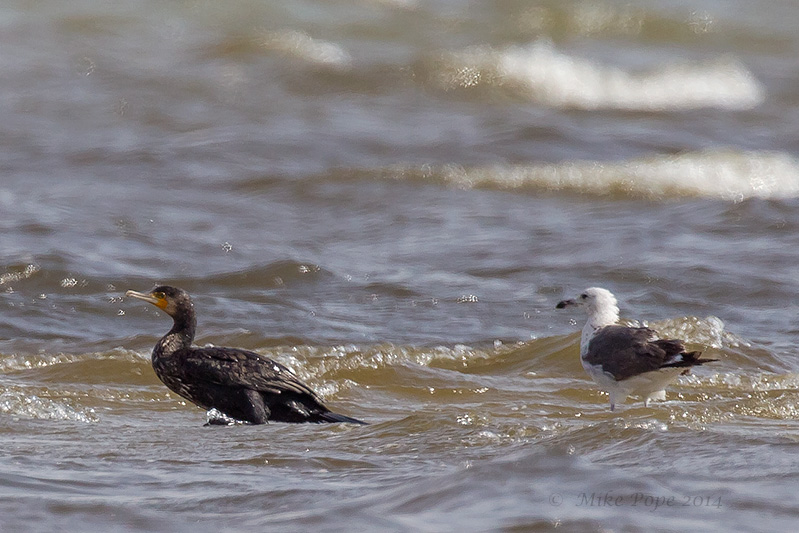
It is pretty early in the year to get Great Cormorants, but there were already 3 here together with a few large white-headed Gulls


Early Great Cormorant (Phalacrocorax carbo)
I found this fast moving wasp like insect on the sabkha and have no idea what it is - any advice would be appreciated.


Wasp sp?