13 July 2013

A few more migrants at Jahra Pools

Week 28, 13 Jul 2103 - Jahra Pools Reserve (Click to enlarge image)

The wind had subsided and traffic during Ramadan is not frenetic at all, so getting to Jahra Pools this morning was a breeze.

Birds were pretty much the same as earlier in the week, but I did see both the Black-winged Kites and spent quite some time trying to get on to a Spotted Redshank in breeding plumage, but to no avail - very frustrating when you know the bird is in the area, but just can't find it!

The wader numbers for Green and Common Sandpiper and Ruff had increased, but only 1 Black-headed Wagtail was seen.

Black-headed Wagtail (Motacilla f. feldegg)
As the temp rises, each circuit of the reserve seems to produce a species you didn't see earlier, so a Citrine Wagtail is always great to see, even if it does not have pristine plumage.

Citrine Wagtail (Motacilla citreola)
Most of the birds never got in range for photographs, so focused on a few Dragonflies which I will need help to identify.

Unidentified Dragonfly

Unidentified Dragonfly
A stop at Jahra Farms on the way home gave a pale white butterfly, with black-tips on the top wings which I have not seen before in Kuwait. I will have to see if I can Google the id..

Unidentified Butterfly

The birds and the butterflies

Week 28, 11 July 2013 - Sabah Al Ahmad Sea City (Click to enlarge image)

A visit to the Sea City project in the south of Kuwait in what is considered to be the hottest month of the year produced very little.

Very little birdlife on the islands, but I did find good numbers of Blue Pansy butterflies - certainly more than I have seen in Kuwait in previous years


Blue Pansy (Junonia orithya)
Since we had the boat, as usual we checked off-shore and found 12 Socotra Cormorants on the off-shore buoys, all but one were 1st year birds


Adult Socotra Cormorant (Phalacrocorax nigrogularis)

Portrait of 1st year Socotra Cormorant (Phalacrocorax nigrogularis)
Heading back to the jetty, I found another inside the project and this is the first time I have seen this species fishing in the lagoons - so it was a pleasant surprise and shows that food is abundant in the lagoons.


Socotra Cormorant (Phalacrocorax nigrogularis) fishing in the lagoon

Early Migrants and a Rarity

Week 28, 09 July 2013 - Jahra Pools Reserve (Click to enlarge image)

There had been reports from Khaled Al Ghanem of 2 Black-winged Kites at JPR which are considered rare dispersers in Kuwait. As I hadn't seen one for quite sometime I decided to pay JPR a visit.

The wind was gentle to start, but increased in speed rapidly during the morning, eventually making conditions unpleasant - but I persevered.

Even the Sand Martins

Sand Martin (Riparia riparia)
and Barn Swallows were temporarily grounded by the wind

Barn Swallow (Hirundo rustica)
There are a number of pairs of Little Ringed Plover around and for sure they are breeding, but we haven't yet discovered any of their nests.

Female Little Ringed Plover (Charadrius dubius)
A few early Autumn migrants have already started to appear in small numbers, like Common Sandpipers

Common Sandpiper (Actitis hypoleucos)
and Wood Sandpipers

Wood Sandpiper (Tringa glareola)
As well as around 5 Black-headed Wagtails, still sporting their breeding plumage

Black-headed Wagtail (Motacilla f. feldegg)
An unexpected Great Cormorant (which is a winter visitor) made an appearance and was immediately harassed by a few White-winged Terns 

Great Cormorant (Phalacrocorax carbo), normally a winter visitor
I noticed a small bat flying around looking for a place to 'hang-out' in the reeds - it was pretty difficult to find it once it had, as it is a really small bat called a Kuhl's Pipistrelle

Kuhl's Pipistrelle (Pipistrellus kuhlii) 


I did a last circuit of the reserve and finally caught up with a 1st year Black-winged Kite, that of course was against the light. I am unsure where these youngsters may have originated from, but always good to see a bird that you haven't connected with for some time.

1st year Black-winged Kite (Elanus caeruleus)


08 July 2013

The Masked Bandit returns

Week 27, 05 July 2013 - Sulaibikhat and Jahra Area (Click to enlarge image)

The 4th record of Masked Wagtail had been seen at Jahra Pools on the 3rd July by Khaled Al-Ghanem, so I was up early in blustery and hot conditions to see if it had stayed a little longer.

I didnt want to wake the guards at the gate too early, so detoured past the outfall at Sulaibikhat to discover that many of the birds that had bred on Boubiyan Island this summer were now back on the coast along with many young 1st-year birds. Gull-billed Terns were foraging off the outfall in the early morning light, with the youngster still begging for food whilst in flight with the adult.


Adult Gull-billed Tern (Gelochelidon nilotica)

1st-year Gull-billed Tern (Gelochelidon nilotica)
A very young Crab-plover was seen on the banks of the outfall together with a Caspian Tern


1st-year Crab-Plover (Dromas ardeola) with Caspian Tern (Hydroprogne caspia)
A White-winged Tern was also seen roosting on the bank


White-winged Tern (Chlidonias leucopterus)
This bleached Heuglin's Gull was completely out of place as it should have departed to it's northern breeding grounds at the end of winter with the rest of the flock...


A very bleach Heuglin's Gull in the summer
At a more civil hour I arrived at the Jahra Pools gate. Water is still present but at lower levels, obviously at this time of year evaporation is a huge challenge. I was surprised to see some very early Autumn migrants, but also pleased to see some birds with colour in the form of a small flock of Blue-cheeked Bee-eaters


Early Autumn arrivals, Blue-cheeked Bee-eater (Merops persicus)
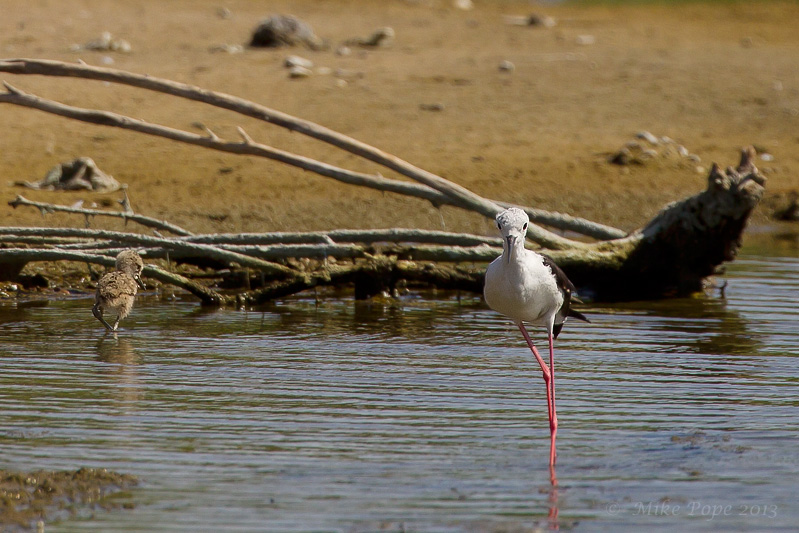
Other species that have had a successful breeding season at JPR were Little Ringed Plovers and the few pairs of Black-winged Stilts


Black-winged Stilt (Himantopus himantopus) and recently fledged young
The Little Grebe off-spring are all pretty independent now


Little Grebe (Tachybaptus ruficollis) adult and almost grown young
As are the Mallard goslings which all appear to have survived till adulthood


The Mallard (Anas platyrhynchos) brood
There were Whiskered Terns wheeling and foraging over one of the larger pools.


Whiskered Tern (Chlidonias hybrida)
I photographed this Dragonfly that I thought may be a Vagrant Emperor, but there are some differences to the one below that I photographed in the South of Kuwait which was identified as a Vagrant Emperor


Lesser Emperor (Anax parthenope) Dragonfly

Vagrant Emperor Dragonfly
I found a single Black-tailed Godwit and it took some time to get into a position where the light was favourable.


Black-tailed Godwit (Limosa limosa)


Just after it took flight, I heard the familiar call of a White Wagtail, but could not locate the bird or where it came from. Finally I saw a movement and discovered it was below the bank, very close to where I had parked and finally I got onto the Masked Wagtail and had some almost full frame moments as it foraged along the waters edge - certainly my best photographic moment for this species.

As mentioned, this is the 4th record for Kuwait and of interest 3 of the 4 records are from Jahra Pools with the 3rd record found on 2nd March of this year.


4th record of Masked Wagtail (Motacilla a. personata)


Driving around the desert area with the Casarina Trees, I found a pair of Rufous-tailed Scrub Robins which was surprising and I am now wandering if they may have bred this summer? A short time later, I found 2 Upchers Warblers even more surprising and sat with them for quite some time to see if they were showing any signs of breeding activity - but none that I could ascertain


One of 2 Upcher's Warbler (Hippolais languida) seen together
A few Blue Pansy butterflies were seen and these are certainly not common in Kuwait


Blue Pansy butterfly
I decided to head to Jahra East and on the way out, a Purple Heron flushed out of the reeds


Purple Heron (Ardea purpurea)
And a juvenile White-tailed Lapwing flew by


Juvenile White-tailed Lapwing (Vanellus leucurus)
It was pretty hot by the time I arrived at Jahra East and discovered that it was already occupied by a large herd of camels and goats, so no chance of much bird activity. I resigned myself to photographing Dragonflies using my big glass, which is actually quite effective.

The first has impressive colouring and flew up and down the channel, but I'm not sure of it's id as I don't have any reference books for Dragonflies


Unidentified Dragonfly
The second appeared a lot more dainty and stayed away from the water, preferring to land on short grass


Unidentified Dragonfly
The last was a Damselfly which I have seen, but they are much more elusive to find after they have flown and landed - again no clue what species this is.


Unidentified Damselfly
By now I was also wilting a little, so decided to head back home

06 July 2013

Cormorants and Turtles

Week 27, 30 June 2013 - Sabah Al Ahmad Sea City (Click to enlarge image)

At the end of June I was down at Sea City and this was one of the least productive visits in terms of birds, as is expected at this time of year.

As expected at this time of year, Socotra Cormorants were roosting on the off-shore buoys along with a few Terns.


Sub-adult Socotra Cormorant (Phalacrocorax nigrogularis)

Having a good scratch

Socotra Portrait
As there was not much else about, we took the boat to a small patch reef and after waiting for 20-minutes were rewarded with sightings of at least 4 large Hawksbill Turtles, the lens I had on was not ideal to show the size of the Turtle. These Turtles breed in Kuwait during the summer on the southern beaches and some of the off-shore islands.

Hawksbill Turtle (Eretmochelys imbricata) surfacing for air


The image below was taken by my friend Anand, a few days after my visit and is obviously the best way to observe a Turtle.


Hawksbill Turtle (Eretmochelys imbricata) more graceful under the water